
Empathy. Empathy is a word that everyone has heard before, but it isn’t one that many truly understand. At least, I hadn’t understood it. Not before I got sick. I hadn’t understood how much that one little word would mean to me at one point in my life.
What is empathy?
Empathy is “the experience of understanding another person’s thoughts, feelings, and condition from his or her point of view, rather than from one’s own” (Psychology Today). When I think of empathy, I think of understanding. Sharing individual experiences. Compassion. Though it seems simple (right?), empathizing with another person is tougher than it seems. Especially when we’re all too busy staring at our phones and whining about how that annoying kid in math class spoiled the ending to the new Avengers movie. (Yes, that was a little shade thrown there.) Despite the fact that empathy and sympathy are words often used interchangeably, the two have VERY different meanings.
Sympathy VS. Empathy
SYMPATHY – “Feelings of pity and sorrow for someone else’s misfortune.” (Dictionary)
EMPATHY – “The ability to understand and share the feelings of another.” (Dictionary)
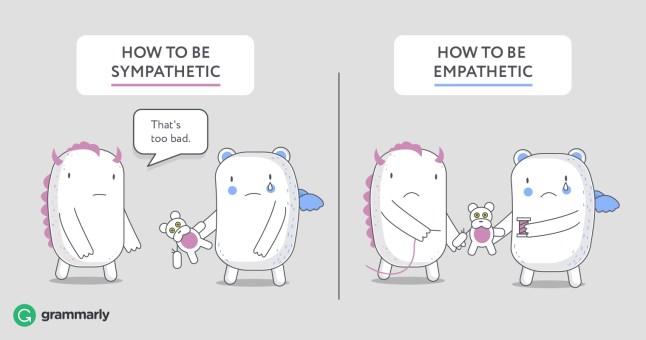
When I was in a pain program (the first time), I was shown a video by a psychologist during a group session that I really connected with. This short video on the difference between sympathy and empathy ultimately helped me to put my feelings about how frustrating it was to be looked at and treated like a “kicked puppy” into words. As helpful as the people around me were trying to be (I think…?), the “I’m sorry” and the “At least you don’t have cancer” and the “It could be worse” wasn’t helping. At all. It actually made me feel worse. After watching this video, I realized that my feelings were validated though I had a right to be frustrated by the ways others were acting, the fact that they couldn’t empathize with me wasn’t because they didn’t want to. It was because they didn’t know how. As Brené Brown explains in the video, empathizing requires a person to feel with another person and be vulnerable. And no one likes to be vulnerable.
If you want to watch this (humorous) 3 minute video, click this LINK.
Empathy in Medicine
I would assume that most people wouldn’t be surprised to hear that some doctors just don’t have good bedside manners. They don’t have empathy. And they certainly don’t like you if their huge brain filled with the names of diseases and their symptoms just can’t seem to pinpoint what’s wrong with you. It’s unfortunate, but it’s not unheard of. I tend to believe that because doctors, surgeons, and nurses see so many gruesome cases, they become immune to understanding or considering the physical or emotional pain a patient with an unusual case, or any case for that matter, is going through. If they’re not dying, they’re not in that much distress. If they’re not suicidal, they’re not top priority. If they’re not the “norm,” they’re faking their ailment for attention or overreacting.
It’s sad to see this happen to so many patients, such as myself. When you participate in that week long study that’s supposed to “fix” you, but the doctor never bothers to call you back. When you leave the hospital after your 3-day stay crying because the doctor implied you were making up your pain and wouldn’t help you further. When your pediatrician, who has known you for your whole life, asks you about your “tummy” pain each visit and says, “It’ll probably go away soon.” Doctors are supposed to be the people who try to understand what you’re going through and from that determine the best treatment possible. But that’s not always how it is. They don’t have to help you. It doesn’t’ matter if that’s their job. They don’t have to do anything.
I’ve found, over the past 3 years, that finding a team or individual doctor that shares your same values and has empathy is key. If you don’t trust or like the people that are treating you, there’s someone else out there in this big world that will listen to your story and see the person behind the illness. Because though empathy is becoming harder and harder to find in medicine, even at the most famous hospitals, it’s not extinct and is still SO important to a patient’s care. We don’t need a robot at our bedside. We need a human.

Outside Resources
To read more about empathy and bedside manner and how it is lacking in the medical field, try out some of the articles below!


 What the Health?!