
Pain
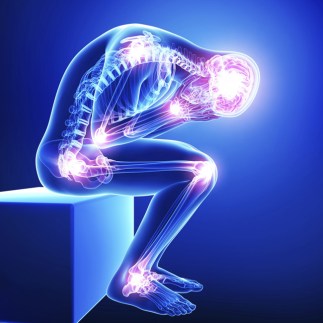
When you type the words “pain definition” into a google search engine, the first explanation you are presented with is as follows: “the physical suffering or discomfort caused by illness or injury.” But what if you begin to feel pain out of the blue for no scientific reason? What if you take Tylenol for that persistent headache and it doesn’t help? What if you ice your knee or use crutches for your foot injury but find no relief? Pain is not black-and-white. There isn’t one perfect solution for every ailment. What works for one person may not work for another.
Although bodies physiologically should perceive pain in the same way because humans have the same anatomy, that’s not always the case. Take me, for example. After a year of abdominal pain, I was diagnosed with Abdominal Cutaneous Nerve Entrapment Syndrome. Patients with ACNES possess a nerve, or several nerves, that are trapped between abdominal muscles, which causes excruciating pain, especially with movement. However, after receiving a lidocaine injection, referred to as a “nerve block,” to the corresponding area of nerve entrapment and a lidocaine infusion that ran through my whole body, which was the normal treatment that was supposed to “fix” me, there was no change. Even though the region of pain has no physical problem anymore, since I was misdiagnosed for so long, my nerves continue to fire false signals to my brain telling me there is something extremely wrong with my body. I was always told that “my nervous system is fried.” It’s hypersensitive to any type of pain or illnesses. While a cold might be a nuisance for one person, it can cause me to be bed-ridden for a week.
Pain Threshold VS. Pain Tolerance
Pain threshold and pain tolerance, although often used interchangeably, are very different. While pain threshold refers to the point at which one feels pain, pain tolerance refers to how much pain one can take until they “crash.” Every person modulates pain differently based on genetics, sex, long-term health issues, psychological factors, social factors, past experiences, and other individual factors. People with chronic pain, specifically, modulate pain differently than the rest of the population. Dr. Moalem-Taylor explains, “Chronic pain patients can have a lower pain threshold because they process pain quickly, but a higher pain tolerance because they are used to living with pain and have adapted to it.” For those of us with chronic pain, it is important to understand the difference between our pain thresholds and pain tolerances. We are used to living with daily pain that would be extremely debilitating to others. However, many of us feel other types of pain, illnesses, or injuries to a greater degree because of the fact that our bodies are also processing other pain. It can be like a computer system becoming overloaded with information that it cannot process at once. Our bodies receive so many pain signals that it cannot comprehend or it believes to be extremely dangerous, so we practically shut down.
Measuring Pain
There is no real way to directly measure pain. “Pain scales,” as many doctors call them, are used to measure an individual’s pain at different points of their treatment. Professionals, supposedly, use this data to compare with other data collected when you return for future visits and are asked again to “rate your pain on a scale from one to ten.” No one can understand another’s pain, no matter what number label your pain. Just because I am at a level “seven” today and not a level “ten” doesn’t mean that my level “seven” is your level “seven.” It could be your level “sixty.”
Acute VS. Chronic Pain
Acute pain and chronic pain are different in every way. Acute pain is a severe pain that is treated within a certain amount of time. Acute pain may be felt when one has an illness, injury, or surgery. Acute pain has a cause for the pain, which is usually a form of tissue damage. The purpose of this type of pain is to alert you that you are hurt and to protect you from any further pain or dangerous activity. In a way, it is meant to convince you to rest and protect the area of harm. On the other hand, chronic pain is pain that is continuous for months or longer. A person may know the reason for their chronic pain. It may have stemmed from an illness, infection, or injury that they never truly recovered from. Nonetheless, chronic pain can also occur with what seems like no reason.
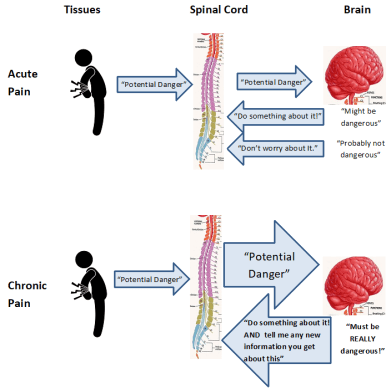
Dealing with chronic pain is physically and mentally exhausting. Every day is a battle. Sometimes, it’s like trying to play a game you don’t know the rules to. One day, you think you have it figured out, but the next day, everything changes. It’s not something that can be easily explained, even to people that you are close to, because no one but you can really understand how you are feeling. Even others with chronic pain have different experiences. It’s not something like cancer, which is a different battle in its own, or rheumatoid arthritis, both of which have specific symptoms and can be diagnosed based off of whether tumors are present, etc. Chronic pain is tough to explain because sometimes you don’t even know how to explain what you are feeling to yourself. I’ve had those days. Despite this, it’s important to remember that even though many people, even doctors, may not understand what you are going through, and many people that don’t have empathy for your situation will try to isolate you, intentionally or unintentionally, you are a survivor all the same. As long as you recognize the strength it takes for you to wake up each day, that’s all that matters.
To learn more of the basics about chronic pain, visit Link.
Written Sources
“Understanding Pain.” Mayo Clinic, Mayo Foundation for Medical Education and
Research, 26 July 2016, http://www.mayoclinic.org/understanding-pain/art-20208632.
Accessed 6 Nov. 2018.
Martin, Laura J., editor. “What Is Chronic Pain Syndrome?” WebMD, 2017,
www.webmd.com/pain-management/chronic-pain-syndrome-overview#1.
Accessed 6 Nov. 2018.
Brancatisano, Emma. “Why Do Some People Feel Pain Differently?” HUFFPOST,
Huffington Post, 10 Nov. 2016, http://www.huffingtonpost.com.au/2016/10/10/
why-do-some-people-feel-pain-differently_a_21577905/. Accessed 6 Nov. 2018.
 What the Health?!
I like that you have your own personal experience and you seem very passionate about the topic! It was interesting and very well written, good job!
LikeLike
I’m glad you liked it! Thank you for stopping by! 🙂
LikeLike
I really loved reading this. It helped me understand different types of pain that people experience and how pain is not a binary subject. Thanks for sharing your personal experience too!
LikeLike
I’m glad you were able to learn from it! I had to learn the hard way about this matter, but I like to think that if I educate others around me about it as much as I can than they will be better off if they ever encounter a family member or close friend that is dealing with some sort of consistent pain because it is not uncommon! Thank you for stopping by!
LikeLike